

In This Section
Reading
'The more that you read, the more things you will know. The more that you learn, the more places you’ll go.' - Dr. Seuss
Curriculum Intent
At Nicholas Hawksmoor Primary School, we believe that reading is the cornerstone of a child's educational journey. Our intent is to nurture confident, enthusiastic readers who not only master the skill of reading but also develop a lifelong love for books. We aim to:
- Ensure every child learns to read as quickly and effectively as possible, recognizing that reading is fundamental to all aspects of learning.
- Foster a genuine enthusiasm for reading, encouraging children to read for pleasure and personal growth.
- Expose children to a diverse range of high-quality texts that cover various themes, topics, and cultures, reflecting our commitment to quality education.
- Develop critical thinking and inference skills, enabling children to engage deeply with texts.
- Prepare children to become confident and competent readers by the time they leave our school, reading at an age-appropriate level.
Our approach embodies our school's ethos of 'Quality, Enthusiasm, and Partnership', as we strive to provide excellent reading instruction, inspire a passion for reading, and work closely with families to support their child's reading development.
Implementation
To achieve our intent, we implement a comprehensive and multi-layered approach to reading instruction:
- Early Years Foundation Stage: Create a word-rich environment with daily exposure to stories and picture books. We encourage 'reading' of pictures, making inferences, and predictions. We iIntroduce the 100 high-frequency words, followed by an additional 200 words in Year 1.
- Phonics and Guided Reading: Provide a structured phonics program to develop decoding skills. Conduct guided reading sessions in small groups, starting in Reception and continuing through Key Stage 1 and Lower Key Stage 2.
- Book Talk Approach: Introduce 'lenses' for analyzing texts in Early Years and Key Stage 1. Expand on these lenses in Key Stage 2 to structure guided reading sessions, encouraging independence and collaborative skills.
- Whole-Class Reading: Implement daily 'class read' sessions to expose all pupils to high-quality literature. Use shared reading to model reading strategies and enthusiasm for books.
- Interventions: Provide additional support through 1:1 sessions, small group work, and inference training to ensure all children keep pace with their peers.
- Partnership with Families: Engage parents and carers in supporting their child's reading journey at home. Provide resources and guidance to families to encourage reading outside of school.
Our strategy uses evidence-based approaches, provides engaging and varied reading experiences, and develops partnership through collaboration with families and among pupils.
Impact
The impact of our reading curriculum is evident in the following outcomes:
- Reading Proficiency: Children leave Nicholas Hawksmoor as confident and competent readers, able to read at or above age-appropriate levels. High standards in reading are achieved across all year groups.
- Love for Reading: Pupils demonstrate enthusiasm for reading, choosing to read for pleasure independently. Children engage in discussions about books and recommend reads to their peers.
- Critical Thinking: Pupils show improved inference and analytical skills when approaching texts. Children can apply their 'Book Talk' lenses to understand different aspects of texts and their impact.
- Cross-Curricular Application: Reading skills are successfully applied across the curriculum, supporting learning in all subjects.
- Preparation for Future Learning: Pupils are well-prepared for the reading demands of secondary education and lifelong learning.
- Community of Readers: A school-wide culture of reading is established, with shared experiences around books and stories.
- Family Engagement: Increased parental involvement in supporting reading at home, strengthening the home-school partnership.
We continually assess the impact of our reading curriculum through formative and summative assessments, pupil voice, and ongoing monitoring of reading progress. This aligns with our ethos of quality, as we strive for excellence in outcomes; enthusiasm, as we measure engagement and love for reading; and partnership, as we involve the whole school community in celebrating reading achievements.
Early Years Foundation Stage (EYFS)
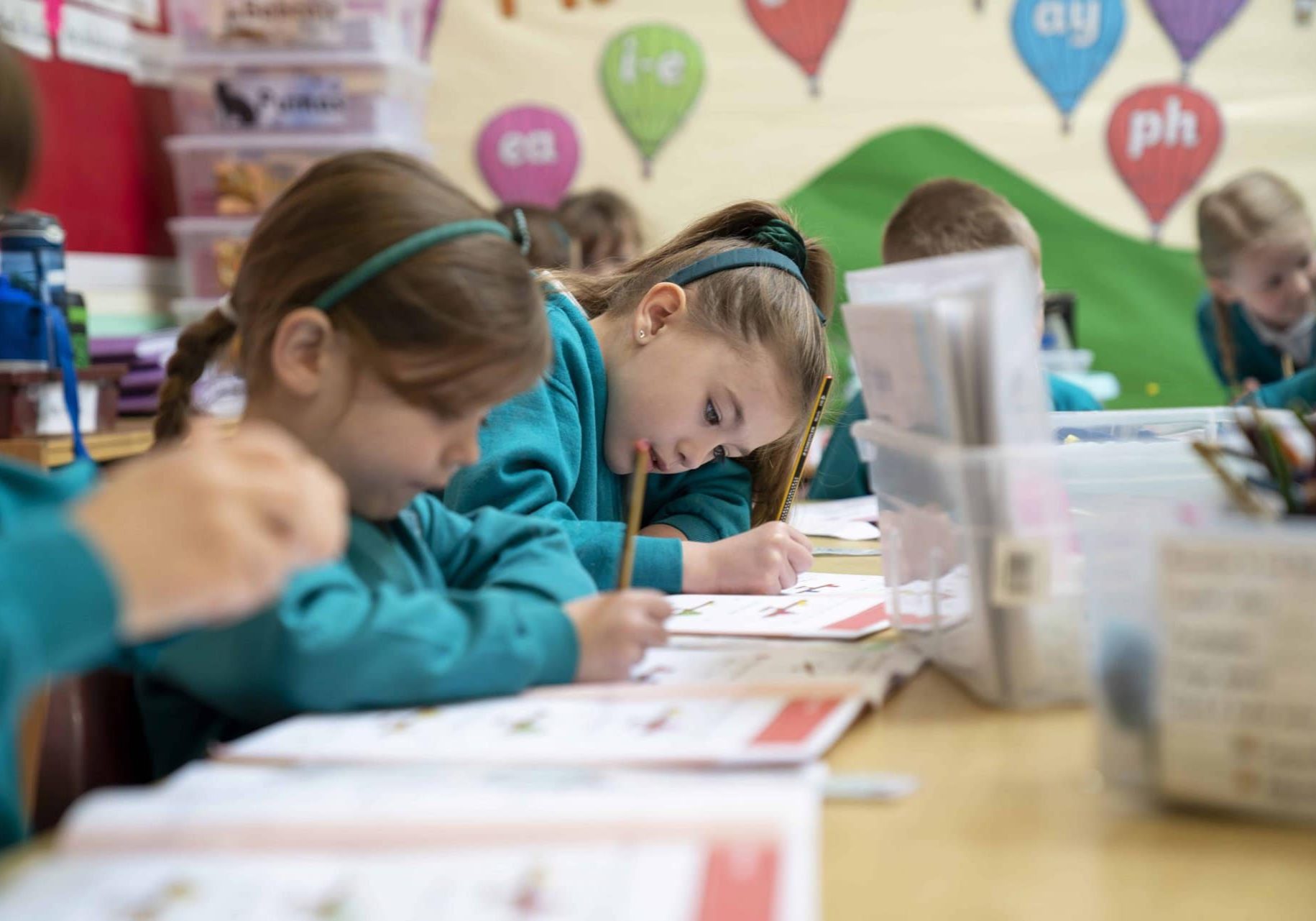
In EYFS, we believe that all children can become fluent readers and writers. We teach reading through Read, Write Inc, a systematic synthetic phonics approach. Starting in Reception, this programme ensures children build on their alphabetic knowledge, mastering phonics to read and spell as they progress through school. Daily phonics sessions and interventions support children to keep up.
Our Early Years pupils love books and explore them across various settings, including the outside classroom, book corners, role play areas, and creative spaces. Books permeate their daily school life, and they enjoy taking home both decodable practice books and a wide range of sharing books on various topics.
The Early Learning Goals for English in the EYFS framework are:
- Listening, Attention, and Understanding: Respond attentively, ask questions, and participate in discussions.
- Speaking: Engage in discussions, offer ideas, and use recently introduced vocabulary.
- Comprehension: Retell stories, anticipate key events, and use new vocabulary.
- Word Reading: Recognize sounds for each letter, read words by sound-blending, and read simple sentences and books.
For more information on reading and writing in the foundation stage, please visit our EYFS curriculum tab and the Early Reading and Phonics page.